Muizzu Tells COP31 Vulnerable Countries Should Not Have to Borrow to Cope with Climate Change
In Antalya, the President called for grant-based climate finance, changes to how lenders and credit rating agencies judge resilience spending, and more money for adaptation and the Loss and Damage Fund.
The News
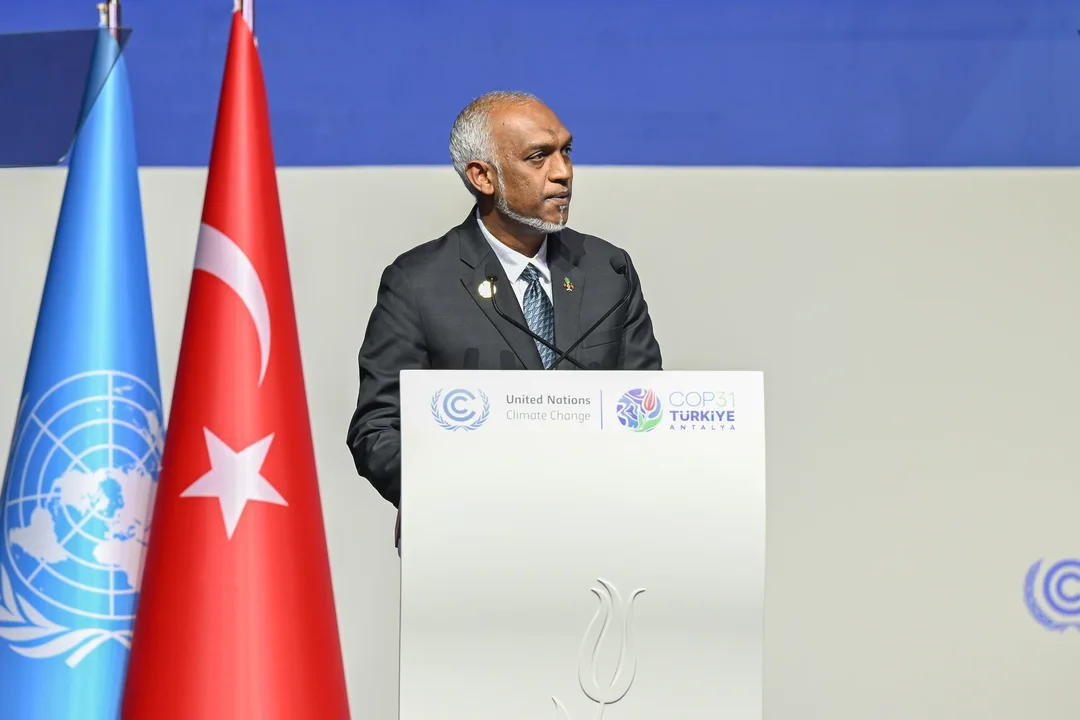
President Mohamed Muizzu has returned from the UN climate conference, COP31, in Antalya, Türkiye, after calling on wealthier countries to pay for climate action with grants rather than loans.
Delivering the Maldives' National Statement on 11 November, he set out three priorities: finance, reform and implementation. Climate finance should be "new, additional, predictable and grant-based", the President's Office reported him as saying, and vulnerable countries should not be expected to borrow their way out of a crisis they had done little to create.
He called for the Green Climate Fund to be replenished, the Adaptation Fund to be adequately capitalised and the Loss and Damage Fund to be sufficiently resourced.
The President returned to the Maldives on 14 November.
Know More
Muizzu also asked international financial institutions and credit rating agencies to rethink how they assess climate investments, treating resilience as an investment in the future rather than a financial liability.
He repeated the point at a meeting of Alliance of Small Island States leaders with UN Secretary-General António Guterres on 12 November. Existing arrangements often push vulnerable countries into expensive borrowing, he said, which adds to their debt and limits their fiscal space. He called for more adaptation finance and urgent replenishment of the Loss and Damage Fund, citing the anticipated "Super El Niño". He also said the Maldives aims to reach developed-country status by 2040, and that climate change is one of the biggest obstacles to that goal.
At a session on clean energy, he said the country's dependence on imported fuel makes cutting it a national priority. He pointed to the target, set in 2023, of generating 33% of the country's electricity from renewable sources, and said meeting it would need substantial investment in renewable generation and energy storage. Spreading infrastructure across scattered islands raises the cost of building and maintaining it, he added.
In the National Statement, the President also cited the Green Climate Fund's recent accreditation of the country's first national direct access entity. The President's Office said it was the first such accreditation for an Asian small island developing state.
Step Back
The Green Climate Fund accredited the Malé lender MFLC in October, as Maldives Today reported, allowing it to develop funding proposals itself.
COP31 opened on 9 November and runs until 20 November. On 4 November, the UN Environment Programme estimated that developing countries will need about US$305 billion a year by 2035 to adapt to climate change, as Maldives Today reported when the conference opened.
Maldives Today has also reported on the strong El Niño expected to peak in December, with seas around the Maldives running up to 2°C above normal.
Muizzu also attended COP28 in Dubai in 2023 and COP29 in Baku in 2024. During this visit he met UNDP Administrator Alexander De Croo, the President's Office said.