
Maldives joins first UN conference on phasing out fossil fuels
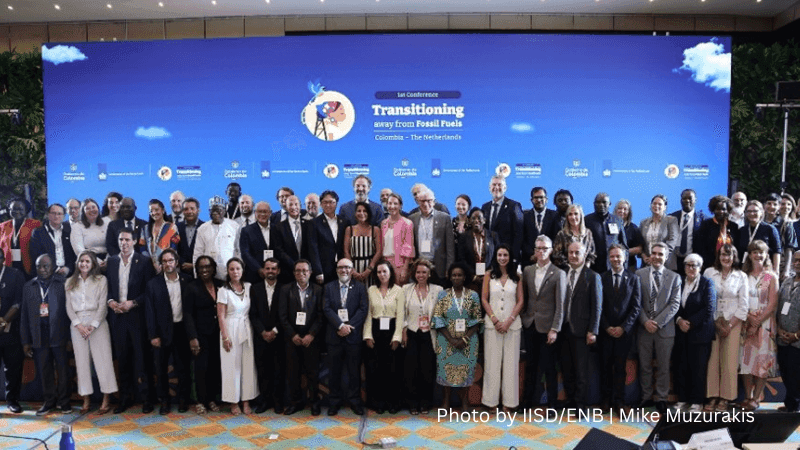
The Maldives took part in the high-level opening of the first United Nations Conference on Transitioning Away from Fossil Fuels, joining a small group of climate-vulnerable states pressing for a binding global timetable to wind down coal, oil and gas production. The conference, which opened on 29 April 2026, follows from the agreement reached two years earlier in Dubai, where the world's governments committed for the first time to a "transition away" from the fuels that account for the bulk of greenhouse-gas emissions.
The Maldivian delegation was led by the Ministry of Climate Change, Environment and Energy, with the country's submission stressing the structural unfairness of an emissions trajectory the islands had no part in setting. The Maldives is responsible for a vanishing share of global carbon output but stands to lose more, in proportional terms, than almost any other state if the international community fails to bring fossil-fuel use within Paris Agreement limits. With ninety per cent of the country lying within a metre of mean sea level, even the lower bound of projected sea-level rise this century would put substantial parts of the inhabited atolls under water during the highest tides.
In its opening statement, the delegation made three asks of the conference: an internationally agreed phase-down schedule for new oil and gas exploration; a step-change in the scale and accessibility of climate finance for adaptation; and recognition of "loss and damage" funding for islands already bearing the costs of warming seas, coral bleaching and the saltwater intrusion that has rendered freshwater lenses on some inhabited islands unusable.
The country has pursued a parallel domestic agenda. Its updated Nationally Determined Contribution targets net-zero emissions by 2030, conditional on international finance, and the Ministry has said new solar capacity in the Greater Malé area is expected to displace a meaningful share of imported diesel within the medium term. Generation from rooftop and floating solar projects has grown rapidly over the past three years, and a planned offshore wind feasibility study is scheduled for the second half of 2026.
The conference itself is significant for what it tries to do: take the abstract Dubai language about transitioning away from fossil fuels and turn it into something countries can be held to. Earlier rounds of climate diplomacy have produced commitments on emissions and on temperature targets, but never an agreed phase-down on the production side. Civil-society groups have argued that a credible global response now requires both. Producer states have resisted, on the grounds that any phase-down schedule must be paired with finance for diversification.
For the Maldives, the politics are uncomplicated. The country has no domestic oil and gas industry and imports almost every drop of fuel it burns. Its economic exposure runs the other way — through the price of jet fuel, the cost of running diesel generators on resort islands, and the freight bill on every imported container of food and construction material. Reducing the world's reliance on fossil fuels would, on every one of those margins, make the Maldivian economy more resilient.
The delegation is expected to back proposals for a "fossil-fuel non-proliferation treaty," an idea championed by a coalition of Pacific and Caribbean small island states and now formally endorsed by more than a dozen governments. The proposed instrument would impose a moratorium on new exploration licences, accelerate the wind-down of existing production in line with science-based budgets, and channel finance to a "just transition" in producer countries that depend on hydrocarbons for revenue.
Officials in Malé have framed the conference as part of a longer arc that began with the Maldives co-founding the Alliance of Small Island States in 1990. Under the Alliance, the country has played a coordinating role at successive Conferences of the Parties — most prominently at COP15 in Copenhagen, where then-President Mohamed Nasheed used a televised underwater cabinet meeting to make the point that climate inaction was an existential matter for the islands. The argument has not changed in the years since. What has changed is the political space for it: the inclusion of a fossil-fuel transition in the COP28 outcome was a long-fought breakthrough, and the conference now under way in New York is the logical next step.
The Ministry confirmed that bilateral meetings on the conference margins included discussions with European, Caribbean and Pacific counterparts on coordinated drafting positions, and with multilateral lenders on adaptation finance pipelines. A delegation summary is expected later this week.
More from Environment